ARTS and CRAFTS
TRADITIONAL CUSTOMS AND PRACTICES
indian-heritage collection of kolams
Step by step instructions to draw kolams
Display of kolams shared by visitors to the site
Kolams and rangoli executed with powder and flowers
and
Kolams collection reproduced on paper
Kolams are a symbol of
auspiciousness. It is Hindu belief that that
the geometrical patterns and designs applied with
rice flour at the entrance to a home, invites
Goddess lakshmi into the household, and drives away
the evil spirits. It is mostly a South Indian
tradition, practised widely in Tamilnadu.
Kolams are also applied daily in the pooja room near
the lamps. There are specific kolams
attributed to the various deities.
Traditionally, the
women wash the path in front of the house. (Cowdung
is used to clean up the ground, though this practise
is no longer in vogue in the cities, mainly because
cowdung is not easily available and most entrance
path are now laid in cement or tiles.) Finely
ground rice powder is then used to apply
kolams. This practice is followed in the
evenings also.
The reason for using rice flour is that we are
providing food for the ants and other small
insects. In these days finely ground white
stone powder is used, for this is easier to apply
and also the kolams are brighter and well
finished. Even if ground stone powder is used,
one could mix rice flour in it.

Kaavi (brick red powder) is applied as an outline,
especially on special occasions and pooja days.
In places, where there is a great gathering of
people and movement, rice paste made by mixing
rice flour with little water is used to apply
kolams. This is to ensure that the kolams are
not rubbed off easily. This is especially
applied in temples and wedding halls. During
Krishna Jayanthi, tiny feet symbols are drawn using
the rice paste from the entrance of the house
leading upto the pooja room, where the sweets made
for the occasion are placed. It is assumed
that child Lord Krishna walks into each house and
partakes of the meal provided.
The month of margazhi (mid Dec) is a
gala time for all kolam lovers in the cities and
villages. Women start applying huge
beautiful kolams very early in the morning
undaunted by the chill morning dew. They
start learning kolams and make preparations
overnight testing the kolam on paper so that they
can do a perfect job the next morning. There
is a healthy competition in each street, each
trying to outdo the others. The current trend is
to create colourful rangolis (rang - colour in
Hindi) applying colour powders to fill up the
white outlines.
Kolams are known by different names in
different parts of India. Hase in Karnataka,
muggulu in Andrapradesh, chowkpurna in Uttar
Pradesh, alpana in Bengal and Assam, and rangoli
in Gujarat and Maharashtra.
- Information about different names in
different parts of India from (http://www.auroville.org/ environment/villages/vill_kolam.htm)
There are several types of kolam designs
- line kolams, the free hand drawing of
lines to make a geometrical pattern.
Pulli (dots) are arranged in a specific
sequence and order and these pullis are joined
to make pictorial designs.
In pulli kolams, there are two types
- joining the dots with straight lines to
create the pattern.
- forming of twisted chains by linking one
loop with the next and forming
wonderful designs. This is called Neli,
chikku, sikku, kambi or chuzhi kolam.
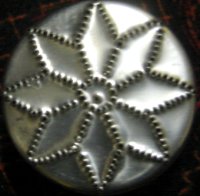 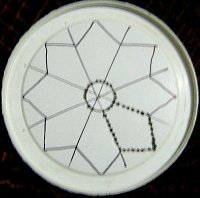 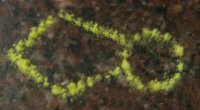
Plates, Boxes are available with the designs
etched as tiny holes. When these are filled
with kolam powder and tapped on the ground, you
have a lovely kolam. Rollers are also
availabe. The rollers are filled with kolam
powder and rolled/dragged to create lines
orpatterns, and with a little imagination a kolam
of your choice can be executed. The 1st
image is a kolam box made of steel. The 2nd
image is a hand made plate, the dots pierced using
a sharp hot nail on a plastic lid and the third
image is the result using the plastic kolam
plate.
Several other rangolis are practised -
with flowers (very
popular in Kerala during Onam), on water, using items suited to the
occasion.
Related Links
https://www.facebook.com/Vaishalis...
https://www.facebook.com/360...
https://www.facebook.com/3604...
http://www.ikolam.com/blog
http://kolangal.kamalascorner.com/
http://www.youtube.com/user/shonan0
|